Showing posts with label Press. Show all posts

Thursday, April 19, 2007

Deccan Herald - Interview 8 Apr '07


Familiar ground

Utpal Borpujari in an interview with Geeta Abraham Jose, whose first novel is about her own community, the Syrian Christians

Remember The God of Small Things and the world created in it by Arundhati Roy? It is the same world of the Syrian Christian community of Kerala that Geeta Abraham Jose takes a reader into through her debut novel By The River Pampa I Stood.

An IIT-Chennai alumni, Jose lives in Dubai.A portion of the proceeds from the book is being donated to the Nav Srishti Foundation (an NGO that works for under-privileged women in India) by Srishti Publishers & Distributors.


This is not the first novel with the Syrian Christian community as the backdrop and Arundhati Roy's The God of Small Things is the most famous example of that. How would you describe your novel's theme?

Way back in 1995, I said to myself, ‘Hey, why not write a book using my own community as the backdrop? This is an uncharted territory. So let me write about it.’ That's when my novel was born.

I had almost completed writing it when Arundhati’s novel took the world by storm. I loved her book but I was amazed at the similarities in the theme and the family set up. We come from the same Syrian Christian background and anyone from this background would know the kind of incidents which could raise eyebrows in a highly conservative society like ours. This could be the reason for the similarity in the theme. As for the kind of life that existed in the pre-Independence era, I picked a lot from conversations with people from the older generations of the community.

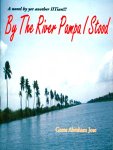
As for the river Pampa, it has always remained close to my heart. I grew up hearing legends about the Pampa and during the hot summer days we cruised on its serene waters through the Kuttanadan plains. What is particularly appealing about Kuttanad is its old-world charm, its slow pace of life and its innocence which remain unchanged.

There seems to be a deliberate attempt to ride on the success of Chetan Bhagat, as the cover page of your book says, “A novel by yet another IITian”. Comment.

My book is not a book about IIT. I guess my publishers are still riding on the crest of the success wave of IITian Tushar Raheja’s novel (Anything for you, ma'am), which they published last year and still remains a hot favourite with teenagers in India. The publishers were attracted to my manuscript because it was penned by another IITian. That could be the reason for the rejoinder on the cover page.

How important was the Syrian Christian backdrop for your first novel?

I chose this background only because I am familiar with the community I was born into and brought up in. I was very particular that the descriptions of lifestyle and traditions be original; only then does the book have literary value. Instead of treading on unknown territory, I chose to walk confidently on familiar ground. I did not need much research for portraying the community's characteristics.

How long did it take for you to conceptualise the storyline and actually write it down?

It took me around two years to complete the novel. In one of my creative moments I must have conjured up the plot. The conceptualisation of the storyline must have taken only a couple of months. When I relocated to Dubai, the manuscript travelled with me and lay dormant in the bottom drawers of my closet. About a couple of years ago I transferred it to a word document on my laptop and gave it a few finishing touches before dashing it off to publishers.

Having been settled in the Gulf, has it allowed to take a more objective view of your society when you wrote the novel?

Sure, it did. But the main portions of the novel were written before I moved to Dubai to join my husband.

Are there autobiographical elements in the novel, since it ends with such an indication?

If it seems so to the reader, then I have succeeded in what I intended it to seem like. I wished that the reader would read it as though it was a true story. Frankly speaking, it is not autobiographical. A few incidents were picked from my associations with senior citizens. The main plot is totally fabricated. I have written in first person using a ‘journal style’ in order to lend credibility to the story.

As a first time author, what kind of experience did you have while looking for a publisher?

Oh, that was really the difficult part. Some publishers sent instant regret letters. Some kept the sample chapters for a long time and nothing ever happened. As I said, initially it was the ‘IITian’ tag that caught the attention of Srishti Publishers— who are well known to provide a platform for amateur writers— and then the manuscript was read and appreciated by the editor. Many a manuscript is born to blush and die unseen… You need to send it to the right publisher at the right time.

Sunday, February 25, 2007

The Hindu - First Impressions


THE HINDU FEB 04, 2007
LITERARY REVIEW
FIRST IMPRESSIONS
SUCHITRA BEHAL

By The River Pampa I Stood; Geeta Abraham Jose; Srishti; Rs 100.
IN the backwaters of Kerala stands the Gold House. Its occupants have many stories to tell and some secrets lie locked away till the eldest daughter of the house lies ailing. Always the rebel, she has set her standards way above those around her. She has lived life by her rules. But now, it is time to come clean and as she waits for her favourite niece to be by her side, Annama, as she is now known, wonders about the past. At the same time, her niece discovers different facets of her aunt's life, many of which throw up quite a few surprises. However, she keeps these to herself, promising to fulfil her aunt's last wishes. Spanning over a century, this story also covers the lives of Kerala's Syrian Christian community, a people who abide by age-old conventions abhorring change of any kind.

Friday, February 23, 2007

The Hindu (Kochi Edition) - By the River Pampa I Stood


Metro Plus Kochi
Published on Mondays & Thursdays
Features: Magazine | Literary Review | Life | Metro Plus | Open Page | Education Plus | Book Review | Business | SciTech | Friday Review | Young World | Property Plus | Quest | Folio |

Metro Plus Bangalore Chennai Coimbatore Delhi Hyderabad Kochi

21 Dec 2006

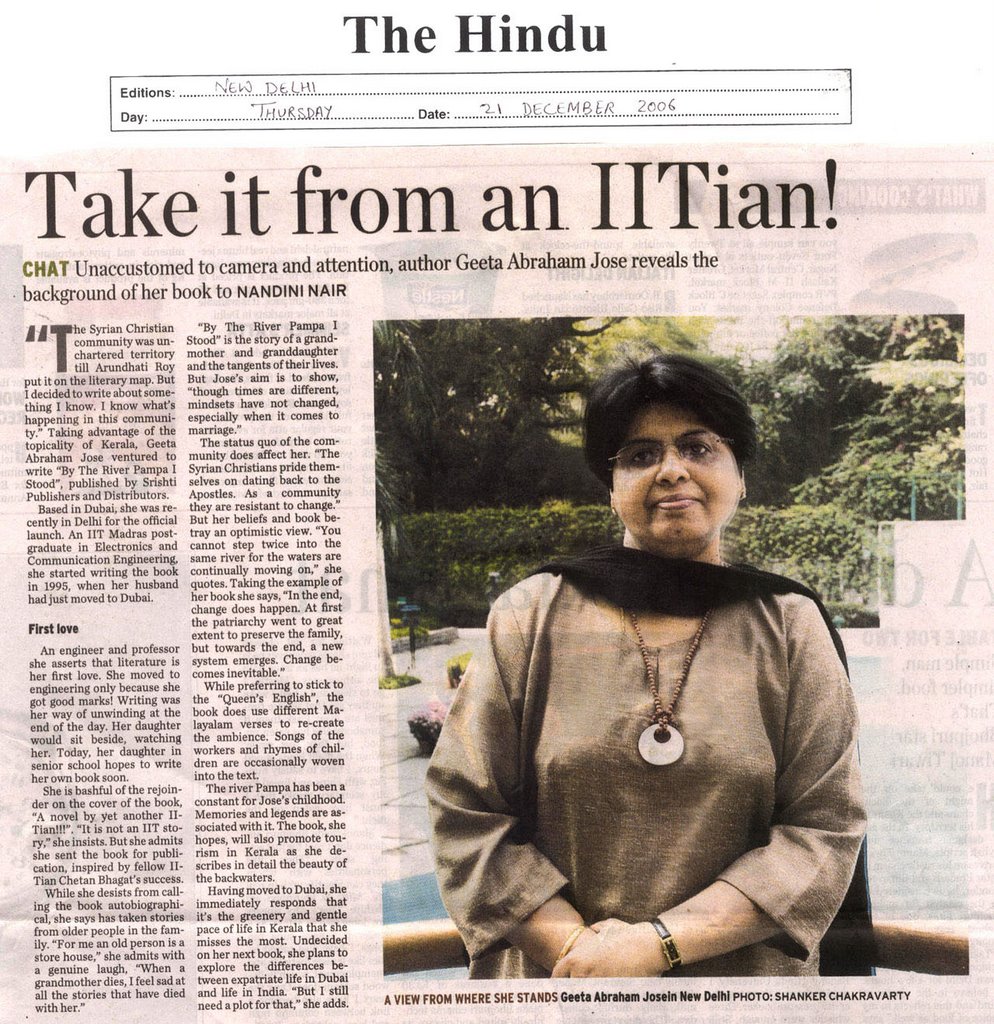
From alongside the Pampa

Geeta Abraham Jose reveals the background of her book By The River Pampa I Stood, which is based on the Syrian Christian community

"The Syrian Christian community was un-charted territory till Arundhati Roy put it on the literary map. But I decided to write about something I know. I know what's happening in this community." Taking advantage of the topicality of Kerala, Geeta Abraham Jose ventured to write By The River Pampa I Stood.

Based in Dubai, she was recently in Delhi for the official launch. An IIT Madras post-graduate in Electronics and Communication Engineering, she started writing the book in 1995, when her husband had just moved to Dubai.

An engineer and professor she asserts that literature is her first love. She moved to engineering only because she got good marks! Writing was her way of unwinding at the end of the day. Her daughter would sit beside, watching her. Today, her daughter in senior school hopes to write her own book soon.

She is bashful of the rejoinder on the cover of the book, "A novel by yet another IITian!!!". "It is not an IIT story," she insists. But she admits she sent the book for publication, inspired by fellow IITian Chetan Bhagat's success.

While she desists from calling the book autobiographical, she says has taken stories from older people in the family. "For me an old person is a store house," she admits with a genuine laugh, "When a grandmother dies, I feel sad at all the stories that have died with her."

By The River Pampa I Stood is the story of a grandmother and granddaughter and the tangents of their lives. But Jose's aim is to show, "though times are different, mindsets have not changed, especially when it comes to marriage."

The status quo of the community does affect her. "The Syrian Christians pride themselves on dating back to the Apostles. As a community they are resistant to change." But her beliefs and book betray an optimistic view. "You cannot step twice into the same river for the waters are continually moving on," she quotes. Taking the example of her book she says, "In the end, change does happen. At first the patriarchy went to great extent to preserve the family, but towards the end, a new system emerges. Change becomes inevitable."

While preferring to stick to the "Queen's English", the book does use different Malayalam verses to re-create the ambience. Songs of the workers and rhymes of children are occasionally woven into the text.

The river Pampa has been a constant for Jose's childhood. Memories and legends are associated with it. The book, she hopes, will also promote tourism in Kerala as she describes in detail the beauty of the backwaters.

by
NANDINI NAIR

Indian Express -By the River Pampa I stood


Indian Express Sunday 15 Jan 2007
Books & Literature
________________________________________
Fresh print
Thursday January 11 2007 19:07 IST

Priya M Menon

By The River
Pampa I Stood
By Geeta Abraham Jose
Srishti Publishers & Distributors, Rs 100

The world got a peek into the life, caste politics and practices of the Syrian Christian community in Kerala with Arundhati Roy’s God of Small Things. Geeta Abraham Jose’s work (a novel by yet another IITian, screams the cover) once again revolves around this very community.

Replace Ayemenem with Kuttanad and the prominent Ponnumpurackal family. Where caste politics still lurk within the folds of Christianity. Where the do’s and don’ts are still dictated by convention.

To the author, then a lonely young girl who has just lost her father, great aunt Annammachi offers solace, comfort and inspiration. But Annammachi is the woman who had dared defy all norms. Who had reversed the do’s and the don’ts with her love for childhood friend and pulaya, Thoma.

The novel, filled with local colour, paints an evocative picture of the typical Syrian Christian/ Nasrani family, its beliefs and time-honoured traditions. The fictional plot sketches characters that are refreshingly real, the author choosing to dwell on the grey areas of life where there are no heroes or heroic acts but just the ordinary human condition.

Femina - By the River Pampa I Stood


Femina 17 Jan 2007